The Data Mesh Revolution in Weather Forecasting
Weather prediction is moving from centralized supercomputers to distributed Edge computing. Learn how the Data Mesh makes forecasts faster and more resilient.
The End of the Monolith
For 50 years, weather forecasting has been centralized. It works like this: Collect data from all over the world, send it to a giant supercomputer (in Reading, UK, or Washington, DC), wait 4 hours for the computer to crunch the numbers, and then distribute the map back to the world.
This "Monolithic" model is hitting a wall.
As we add billions of IoT sensors, drones, and GNSS receivers to the network, the bandwidth required to send all that raw data to a central server is becoming unmanageable. Furthermore, the latency of a centralized run (6 hours) is too slow for modern applications like autonomous driving.
The solution is not a bigger computer. The solution is the Data Mesh.
Decentralizing the Forecast
A Data Mesh architecture moves the processing from the center to the edge. Instead of one giant brain, we use a network of thousands of smaller brains.
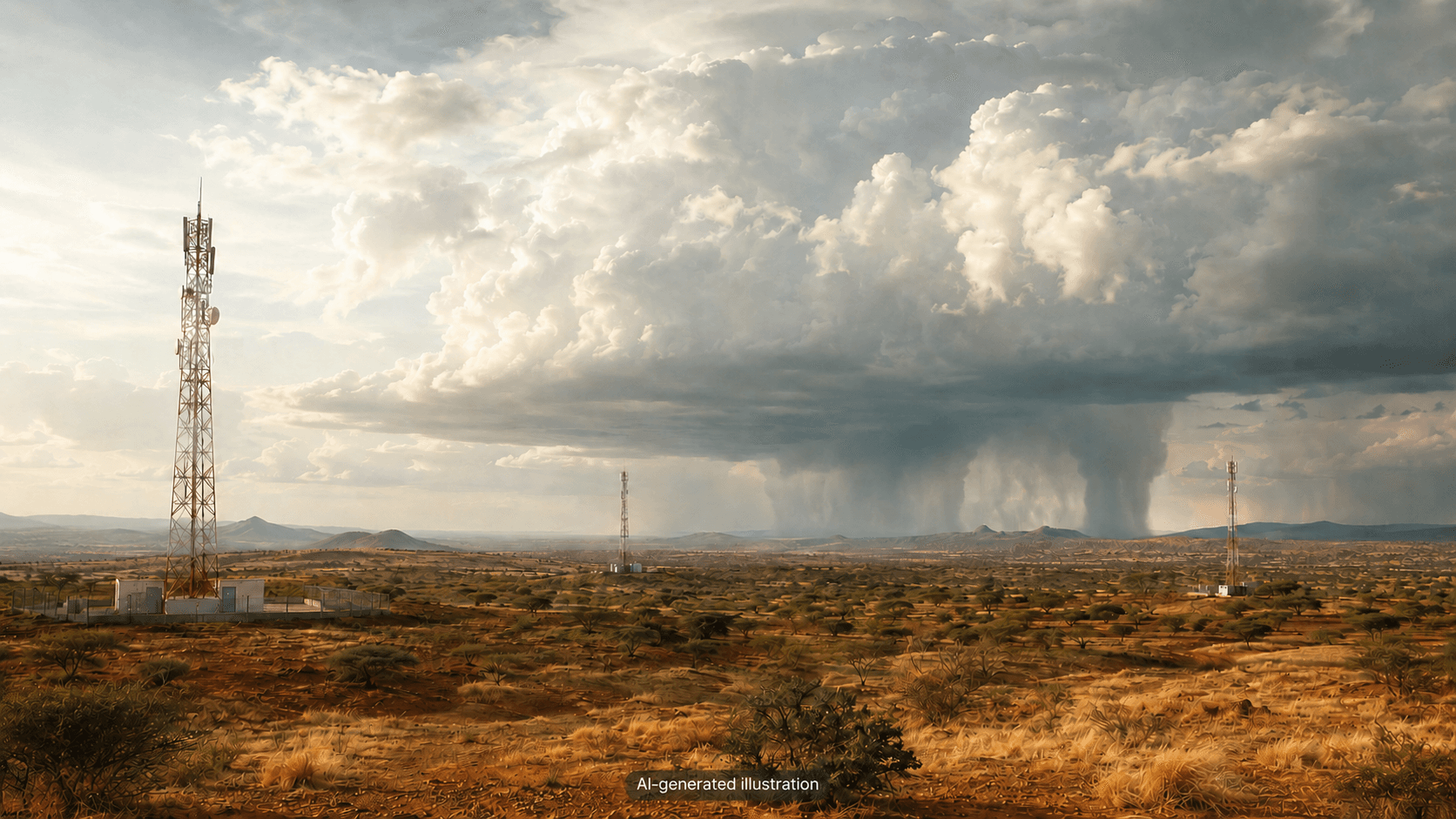
In Skyfora’s ecosystem, the processing of GNSS signal delays happens close to the source, at the "Edge" (often within the telecom network infrastructure itself).
This offers three massive benefits:
- Speed: We don't wait for global data aggregation. Local weather is calculated locally.
- Scalability: Adding 1,000 new sensors doesn't slow down the central server; it just adds more nodes to the mesh.
- Resilience: If the central supercomputer goes offline, the local mesh continues to provide situational awareness.
Deep Dive: How It Works
Imagine a city grid. In a traditional model, every sensor sends raw data to the Cloud.
In a Data Mesh:
- Node Level: The GNSS receiver at Tower A calculates its own "Wet Delay" and shares it with neighbors Tower B and Tower C.
- Cluster Level: The local cluster (e.g., Downtown District) fuses this data to create a micro-model of the city center.
- Federated Learning: The insights from this micro-model are shared with the central system to improve the global map, but the heavy lifting remains local.
This approach mirrors how the internet itself works. It is distributed, robust, and infinitely scalable.
Skyfora's Advantage: Edge-Native Design
Skyfora was born in the era of Edge Computing. Unlike legacy meteorological agencies trying to retrofit 1980s code for the cloud, our stack is cloud-native and edge-ready.
We utilize Kubernetes clusters deployed directly on telecom Multi-Access Edge Computing (MEC) servers. This means our weather algorithms run on the same rack of servers that process your 5G mobile data. The result? Latency measured in milliseconds, not hours.
Practical Applications
- Autonomous Drone Swarms: Drones can share turbulence data with each other in real-time to navigate a city, without needing to ping a server halfway across the continent.
- Disaster Response: During a hurricane, if the main fiber lines are cut, a local mesh of sensors can still communicate via localized ad-hoc networks to provide wind speed data to emergency commanders.
Conclusion
The future of weather isn't a single Oracle telling us the future. It is a nervous system covering the planet, where every node is sensing, thinking, and sharing. The Data Mesh doesn't just make forecasting faster; it makes it unbreakable.