Telco Infrastructure Weather Exposure: Why Cell Towers Fail When Forecasts Are 20km Off
Cell towers fail when forecasts are 20km off. Telco infrastructure weather exposure costs billions. Learn the infrastructure risk.
The 20km Forecast Error
A major telecom operator manages 45,000 cell towers across the United States. Each tower is worth $150,000-$300,000 and serves thousands of customers. The towers are exposed to weather 24/7, but protection decisions are made based on regional forecasts that might be 20km off.
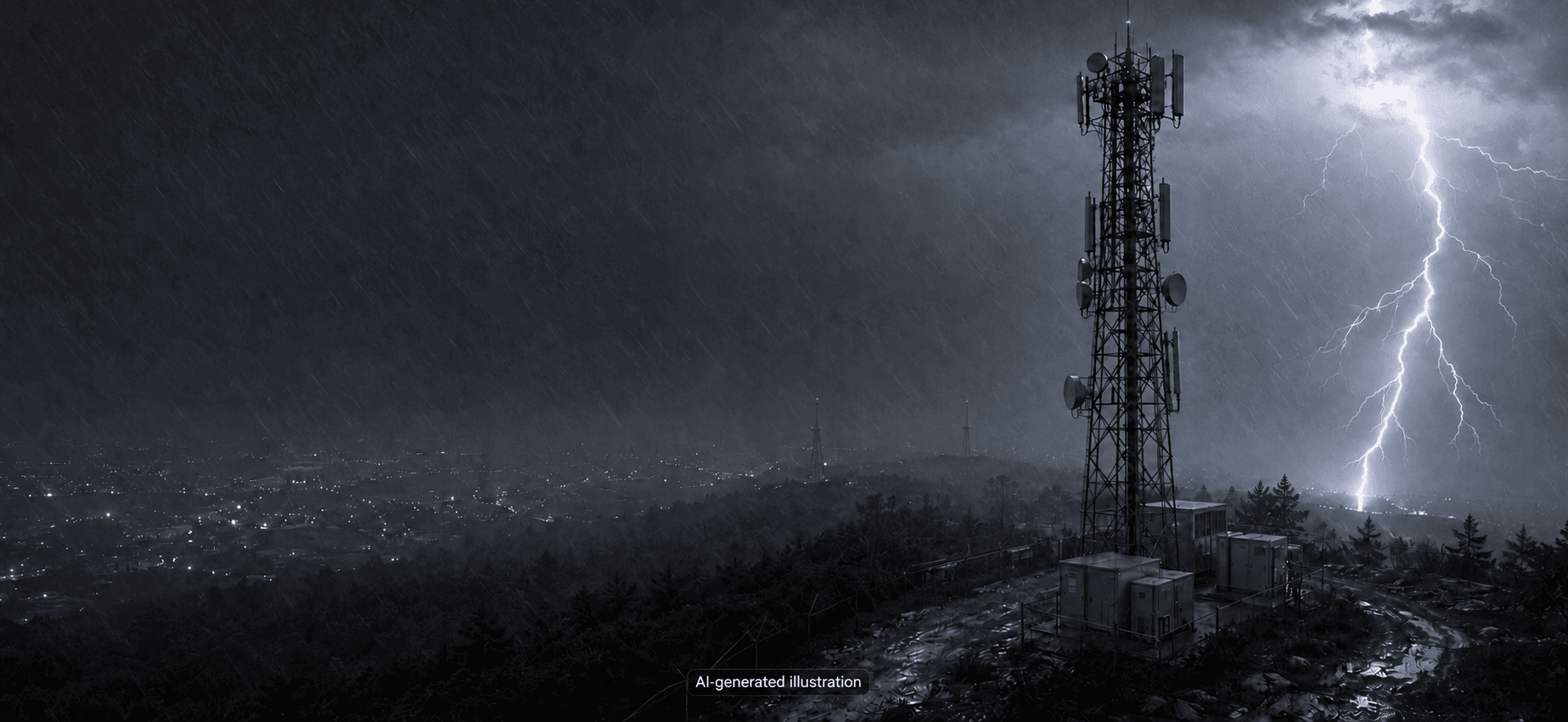
On a stormy afternoon, a regional forecast predicted high winds 20km south of a critical tower cluster. The operator didn't activate protection systems. The actual storm hit the towers directly. High winds and lightning caused 12 towers to fail, cutting service to 180,000 customers for 18 hours. The cost: $2.8 million in repairs, lost revenue, and customer credits.
This scenario illustrates a fundamental problem: telecom infrastructure is hyperlocal—each tower is a specific point—but weather forecasts are regional. A 20km forecast error means protection decisions are made for the wrong location.
The Scale: Weather-related cell tower failures cost telecom operators an estimated $1.2-2.4 billion annually in the United States. Much of this cost is due to forecast errors that cause protection systems to be activated at the wrong towers or not activated at all.
Why 20km Errors Matter
Cell towers are vulnerable to:
- High winds: Can damage antennas, equipment shelters, and tower structures
- Lightning: Can damage electronics and cause power outages
- Ice: Can add weight that exceeds tower capacity
- Flooding: Can damage ground equipment and power systems
Protection systems include:
- Wind monitoring: Shut down or reduce power when winds exceed thresholds
- Lightning protection: Surge suppressors and grounding systems
- Ice monitoring: Heat systems to prevent ice accumulation
- Flood barriers: Protect ground equipment from flooding
The Problem: These systems are activated based on regional forecasts. If the forecast says high winds 20km away, protection isn't activated. If the forecast misses the actual location, towers are unprotected.
Deep Dive: The Hyperlocal Challenge
Telecom infrastructure requires hyperlocal weather intelligence because:
- Point-specific assets: Each tower is a specific location. Regional forecasts don't capture point-specific conditions.
- Rapid changes: Weather can change dramatically over short distances, especially in complex terrain.
- Critical timing: Protection systems must be activated before conditions exceed thresholds, not after.
Case Study: A telecom operator analyzed 47 weather-related tower failures. They found that 31 failures (66%) occurred when actual conditions exceeded protection thresholds, but regional forecasts didn't predict the exceedance at the tower location. The average forecast error was significant.
Skyfora's Advantage: Tower-Specific Weather Intelligence
Skyfora provides hyperlocal weather intelligence for individual cell towers, enabling protection decisions based on actual tower conditions, not regional forecasts.
High resolution forecast models with dense observation grids:
- 1km Resolution: Provide weather forecasts for each tower location, not just regional averages
- Real-Time Updates: 15-minute updates enable operators to track developing conditions at each tower
- Tower-Specific Thresholds: Customized forecasts for each tower's specific protection criteria
- Automated Alerts: Automated alerts when conditions approach or exceed protection thresholds at specific towers
The Impact: A telecom operator using Skyfora's tower-specific enabled intelligence could reduce weather-related failures and significantly improve protection system activation accuracy.
Practical Applications
- Proactive Protection: Operators can activate protection systems at specific towers based on real-time, hyperlocal forecasts, not regional averages
- Maintenance Scheduling: Tower-specific weather forecasts enable operators to schedule maintenance during favorable conditions, reducing exposure
- Emergency Response: Real-time, hyperlocal forecasts enable operators to pre-position repair crews at towers most likely to be affected
- Network Optimization: Operators can optimize network capacity based on tower-specific conditions, maintaining service during weather events
Conclusion
Telecom infrastructure is hyperlocal, but weather forecasts are regional. A 20km forecast error means protection decisions are made for the wrong location, leading to preventable failures and costs. The solution is tower-specific weather intelligence that provides hyperlocal, real-time forecasts for each tower. By providing 1km-resolution forecasts that update every 15 minutes, Skyfora enables telecom operators to protect towers based on actual conditions, not regional averages. For operators managing thousands of towers worth billions, that hyperlocal capability isn't just valuable—it's essential for reliability.