Uncontrolled Water: When Storm Drains Fail and Municipalities Pay the Price
When storm drains fail, municipalities pay billions. Explore how uncontrolled water events bankrupt cities and what can prevent them.
The $1.2 Billion Storm
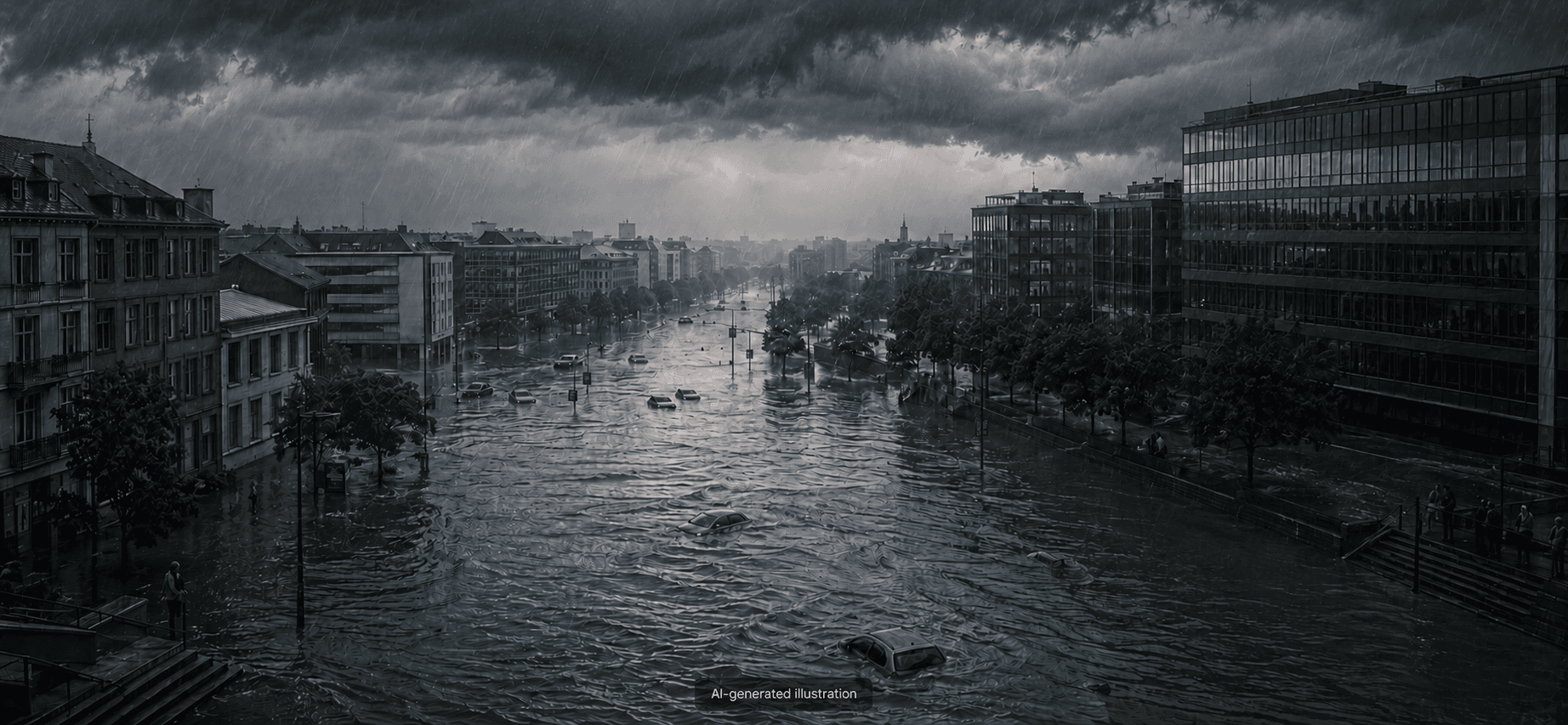
In August 2021, Hurricane Ida dumped 3.1 inches of rain on New York City in one hour. The city's storm drain system, designed for 1.5 inches per hour, was overwhelmed. Water backed up into streets, then into basements, then into subway tunnels. The result: $1.2 billion in damages, 13 deaths, and a city paralyzed for days.
The problem wasn't the hurricane itself—it was uncontrolled water. Once storm drains reach capacity, water has nowhere to go. It flows over streets, into buildings, and through infrastructure. For municipalities, uncontrolled water events are among the most expensive disasters they face.
Globally, urban flooding from uncontrolled water costs cities an estimated $120 billion annually. The cost isn't just in immediate damages—it's in lost economic activity, infrastructure repair, and the cascading failures that follow when drainage systems fail.
When Drains Become Rivers
Urban storm drainage systems are designed around historical rainfall patterns. A typical system might be rated for a "10-year storm"—rainfall so intense it statistically occurs once per decade. But climate change is making extreme rainfall more frequent and more intense.
The physics are simple: when rainfall exceeds drainage capacity, water backs up. But the consequences are complex:
- Street Flooding: Water flows over roadways, making them impassable and dangerous
- Basement Flooding: Backed-up drains reverse flow, flooding basements and ground floors
- Infrastructure Damage: Water infiltrates electrical systems, transit tunnels, and communication networks
- Contamination: Stormwater mixes with sewage in combined systems, spreading contamination
The Scale: A single uncontrolled water event can flood thousands of buildings simultaneously. In Houston during Hurricane Harvey, over 150,000 structures flooded. The average cost per flooded structure: $30,000-$50,000.
Deep Dive: The Capacity Gap
Storm drain systems have fixed capacity—they can handle a certain volume of water per hour. When rainfall exceeds that capacity, the system fails. The critical variable is peak rainfall intensity, and timing, not total rainfall.
Traditional drainage design uses historical data and statistical models. But these models have three fatal flaws:
- Climate Change: Historical patterns no longer predict future extremes. A "100-year storm" might now occur every 20 years.
- Urbanization: As cities grow, impervious surfaces (concrete, asphalt) increase runoff. A drainage system designed for 1980s conditions may be inadequate for 2020s conditions.
- Localized Extremes: Weather models with 10-20km resolution miss local rainfall extremes. A storm might dump 4 inches in one neighborhood while the next neighborhood gets 0.5 inches.
Case Study: A mid-sized city in the Midwest analyzed 12 years of flood claims. They found that the majority of claims occurred when rainfall exceeded the drainage system's rated capacity by 20% or more. The problem: their capacity ratings were based on 30-year-old design standards that didn't account for climate change or urban growth.
Skyfora's Advantage: Real-Time Capacity Monitoring
Skyfora enables flood models to monitor storm drain capacity in real-time by providing hyperlocal precipitation and humidity insights that update every 15 minutes.
Our approach:
- 1km Resolution: Our data can guide rainfall intensity at the neighborhood level, identifying which drainage basins will be overwhelmed
- 15-Minute Updates: As a storm develops, our data enable forecasts updates continuously, giving public works departments time to activate emergency protocols
- Capacity Modeling: By integrating with drainage system maps, we can improve predicting which areas will flood and when, enabling targeted evacuations and resource deployment
The Impact: A city using Skyfora's real-time data capacity may reduce flood consequences significantly.
Practical Applications
- Proactive Drainage Management: Public works can pre-position pumps and barriers in areas predicted to exceed capacity, preventing backups before they occur
- Targeted Evacuations: Instead of evacuating entire neighborhoods, cities can evacuate only the specific blocks where flooding is predicted
- Infrastructure Protection: Critical facilities (hospitals, power stations) can activate flood barriers based on real-time capacity forecasts
- Emergency Response: First responders know exactly where flooding will occur, enabling faster response and resource allocation
Conclusion
Uncontrolled water events are among the most expensive disasters cities face. The solution isn't just bigger drains—it's smarter management. By providing real-time, hyperlocal precipitation and humidity data, Skyfora enables municipalities to manage drainage capacity proactively, preventing uncontrolled water events before they become disasters. For cities facing billions in flood damages, that proactive capability isn't just convenient—it's essential for resilience.