Atmospheric Rivers vs Hurricanes: Understanding the Difference
Hurricanes get the names, but Atmospheric Rivers often bring more rain. Understand the physics differences and why ARs are harder to predict.

The Different Faces of Fury
When we think of a "storm," we usually picture a Hurricane: a swirling vortex with a named eye, wind speeds of 150mph, and widespread destruction.
But for the West Coast of North America, Europe, and South America, the biggest threat isn't a swirling vortex. It is a firehose.
Atmospheric Rivers (ARs) and Hurricanes are both massive engines for transporting heat and moisture, but they operate differently, look different, and require different forecasting approaches.
The Structural Differences
Shape:
- Hurricane: Circular, rotating system. Compact (typically 300-500km wide).
- AR: Filamentary, linear system. Extremely long (2,000km+) but narrow.
Physics:
- Hurricane: Driven by warm ocean water extraction. It creates its own wind through pressure drops.
- AR: Driven by the global jet stream. It is essentially passive vapor being pushed by large-scale winds.
Impact:
- Hurricane: Wind damage is the primary headline; storm surge is the killer.
- AR: Precipitation is the killer. ARs can stall over an area for days, dumping rain. Wind is secondary (though still dangerous).
Deep Dive: The Forecast Challenge
Hurricanes are easier to track. They are distinct objects. A satellite sees a hurricane clearly.
ARs are harder. They are part of the background flow. Identifying the edges of an atmospheric river is difficult because water vapor doesn't have a hard boundary like a cloud wall.
Furthermore, the damage from an AR depends entirely on topography. A hurricane hitting a flat coast causes surge. An AR hitting a flat coast might just rain. But an AR hitting a mountain range (like the Andes or Sierras) wrings out that moisture violently. Therefore, forecasting the angle of impact is crucial. If an AR hits a mountain range perpendicularly, the rain is maximized. If it hits at a glancing angle, the rain is minimized.
Skyfora's Advantage: Mapping the Flux
To forecast an AR, you need to measure Integrated Water Vapor Transport (IVT).
IVT = (Amount of Water Vapor) × (Wind Speed).
Traditional satellites struggle to measure the "Amount of Water Vapor" over land or under heavy clouds. Skyfora’s GNSS tomography excels here.
- Continuity: We track the river as it moves from ocean to land.
- Angle Precision: Because our network is dense, we can resolve the exact vector of the moisture flux. We can tell if the river is hitting the mountains at 90 degrees or 75 degrees, a difference that could mean inches of rain in the forecast.
Practical Applications
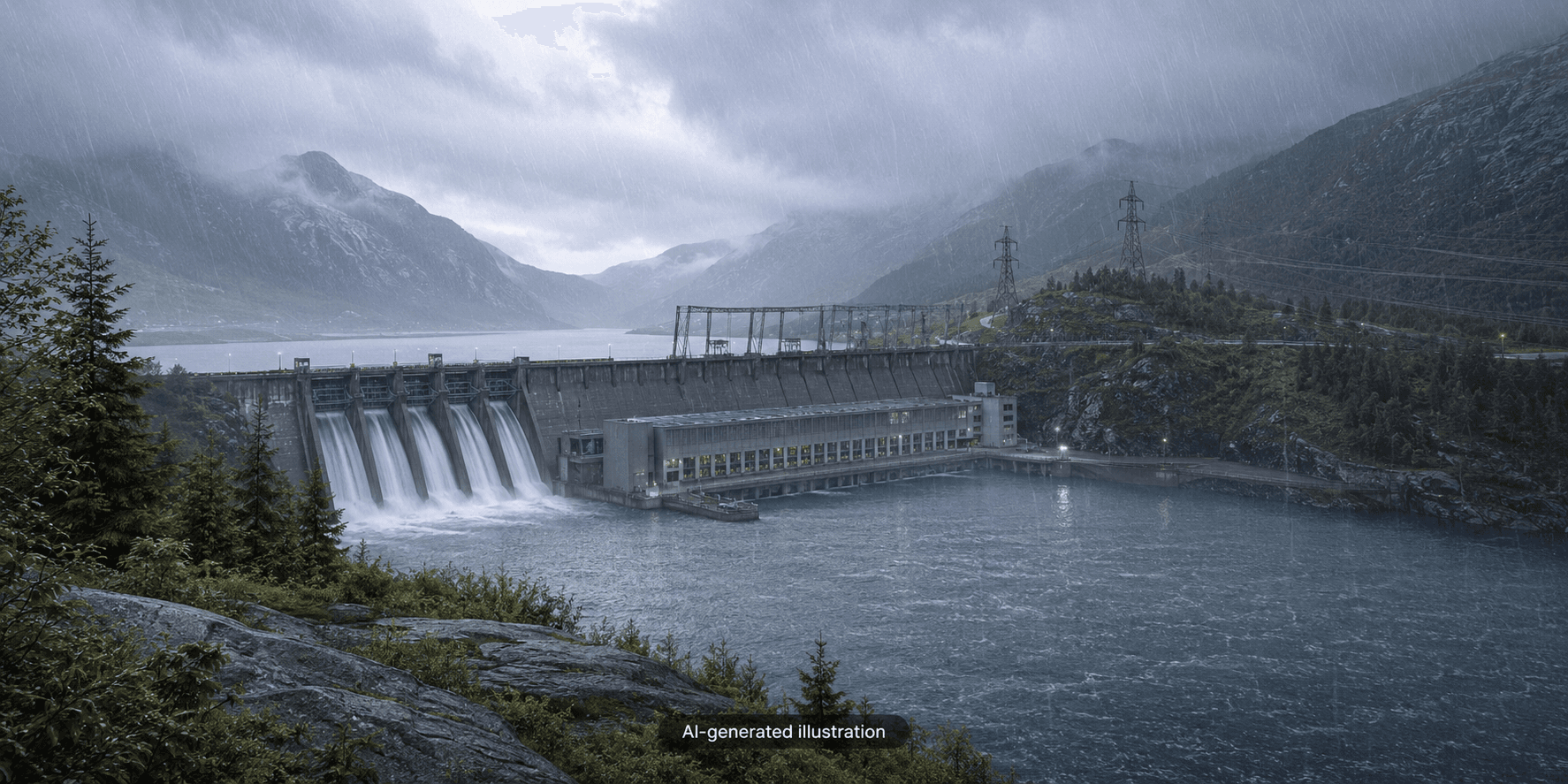
- Hydroelectric Power: Managers love weak ARs (free fuel) but fear strong ones (dam failure). Precise IVT forecasts allow them to balance this risk.
- Road Safety: ARs are notorious for triggering landslides on mountain passes. Department of Transportation crews use our data to close specific passes before the mudslide happens.
Conclusion
Hurricanes are the celebrities of the weather world, loud and photogenic. Atmospheric Rivers are the working class, they do the heavy lifting of the water cycle, but when they work too hard, the results are just as devastating. By respecting their power and measuring their flow with GNSS precision, we can live safely alongside these rivers in the sky.